Ayomitan Adesua

I turn a business question into a costed recommendation.

Data Analyst · Healthcare and operations analytics

What is being decided, by whom, what the data can and cannot carry, and what the answer is worth in money or capacity. Public health is my domain background, so I am most useful where the data is messy, the stakes are real, and the answer has to survive being questioned.

How I work

Every case runs the same six steps.

Most analysis portfolios show a notebook. The hard part is not the model, it is knowing what is being decided and being honest about what the data cannot settle.

The decision

Who is choosing, between what, by when, and what it costs to get it wrong.

The data and its limits

Grain, provenance and what the data cannot carry, written down before any analysis.

Cleaning, logged

Every rule and the rows it touched, so the totals reconcile back to source.

Testing, not fishing

A small set of hypotheses, chosen for what the recommendation rests on, with that choice stated.

The money

A costed option, every assumption in an editable cell, and a sensitivity range around it.

The limitations

On the dashboard, not in a footnote, so no figure is quotable without its caveat.

Case studies

Three decisions, three answers, three sets of limitations.

Healthcare operations

Cutting clinic no-shows and recovering capacity

Which appointments get a reminder, on a fixed budget, and what does that recover?

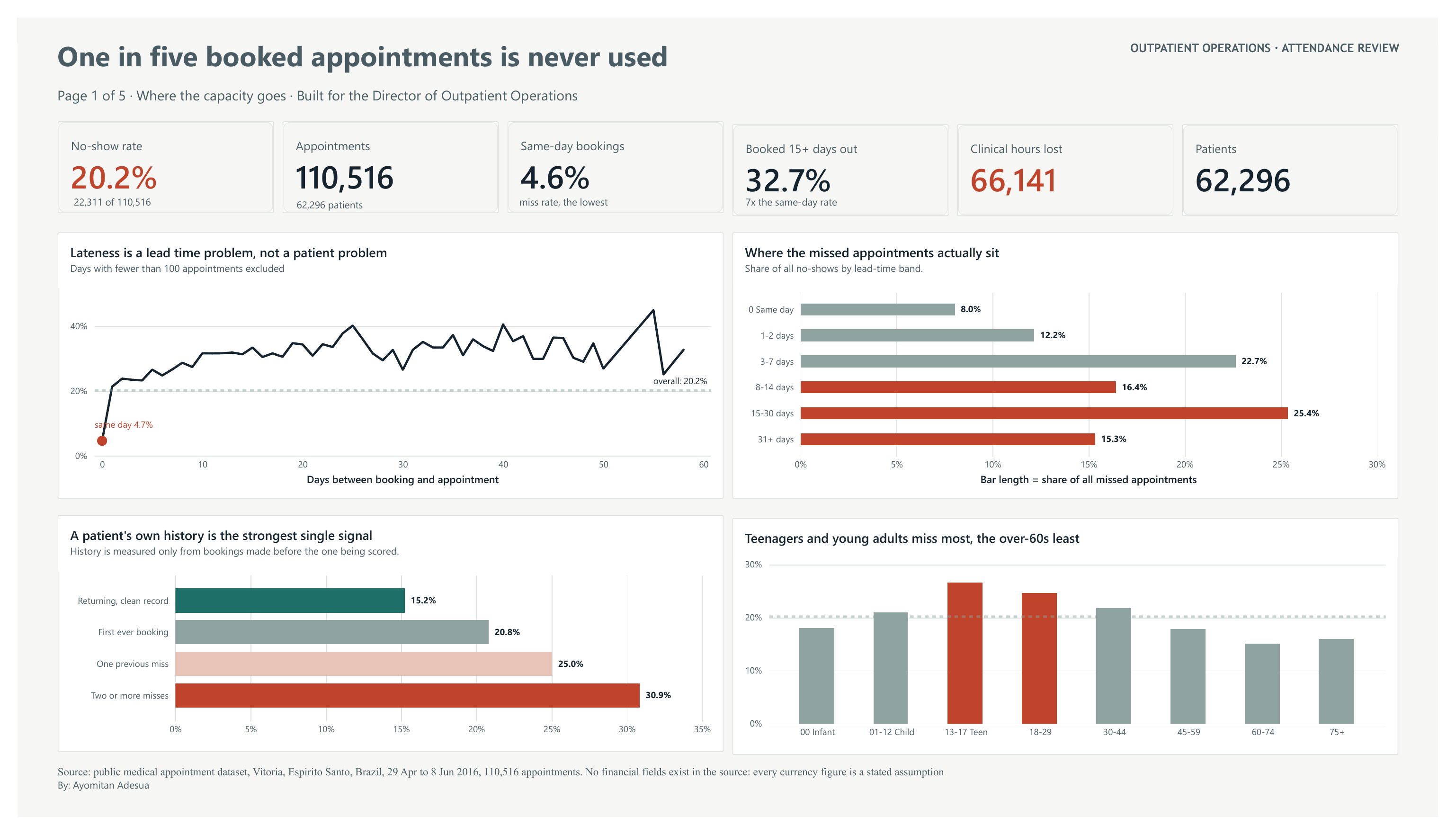
One outpatient appointment in five is never used, which is 66,141 clinical hours a year. The data appears to show reminders make attendance worse. It does not: reminders are never sent on short-notice bookings, and short-notice bookings are the ones patients keep. Correcting for that, adjusted odds ratio 0.78, and the riskiest 20 percent of bookings carry 37.3 percent of all the misses.
  • SQL
  • DuckDB
  • Python
  • Logistic regression
  • Excel
  • Power BI

Read the case

Page one of the clinic no-show Power BI report, showing where outpatient capacity is lost
Page 1 of 5: where the capacity goes.

E-commerce logistics

Reducing cost to serve in e-commerce logistics

Which lever cuts delivery failure: re-route, renegotiate, enforce dispatch, or recalibrate the promise?

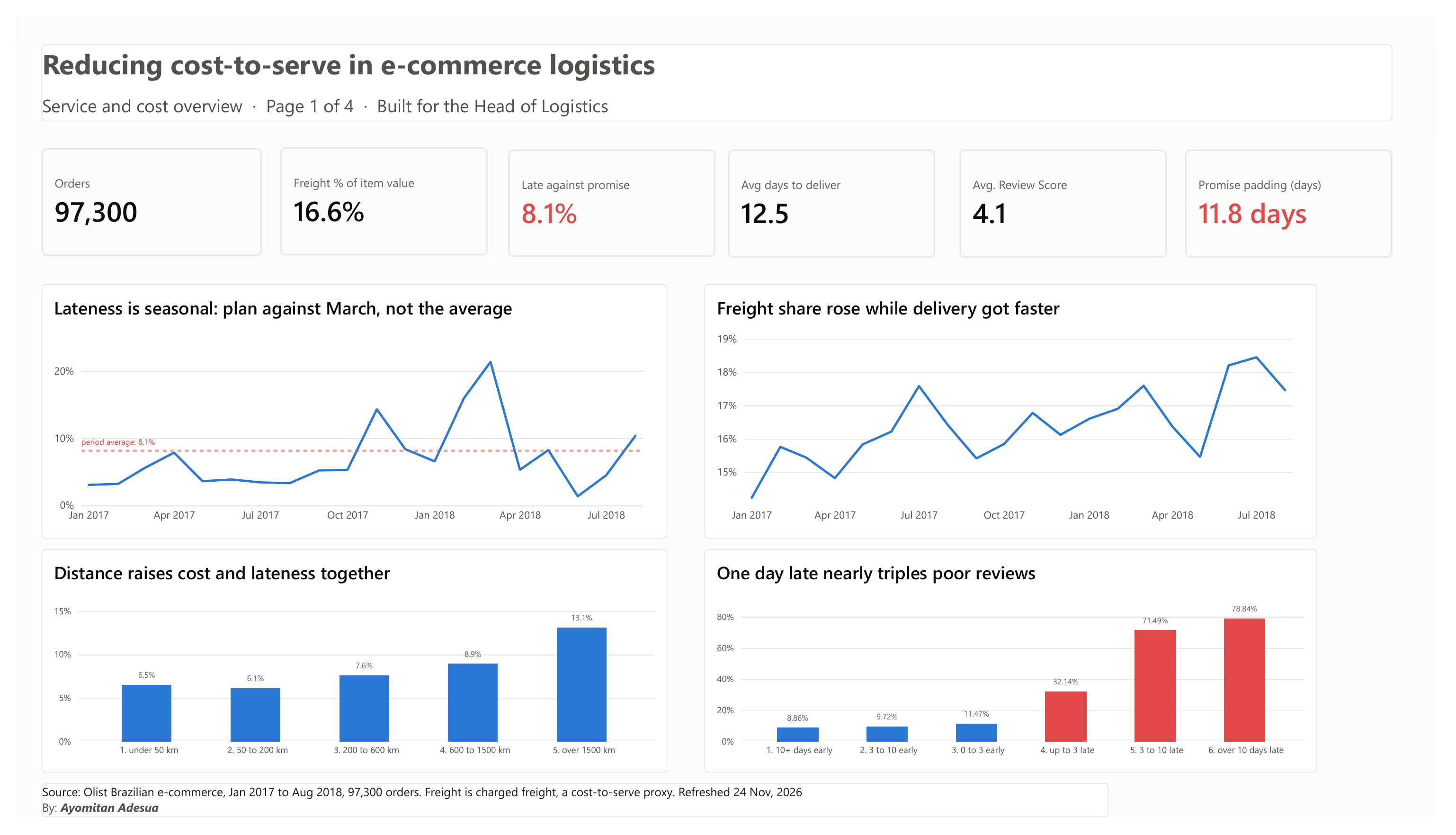
Freight looked like the problem at 16.6 percent of item value. It was not. The blanket delivery promise was. Setting it per lane cuts lateness from 8.1 to 5.0 percent, about 1,697 fewer late orders a year. Cutting three days off every lane instead would have pushed lateness up to 13.1 percent, which is the obvious fix and the wrong one.

  • SQL
  • DuckDB
  • Python
  • statsmodels
  • Excel
  • Power BI

Read the case

Page one of the cost-to-serve Power BI report, showing service and cost overview
Page 1 of 4: service and cost overview.

Public health

Home-based vaccination records in Nigeria

Which gap to close first so children's vaccination records stop going missing: cards never issued, cards lost at home, or the states where both fail?

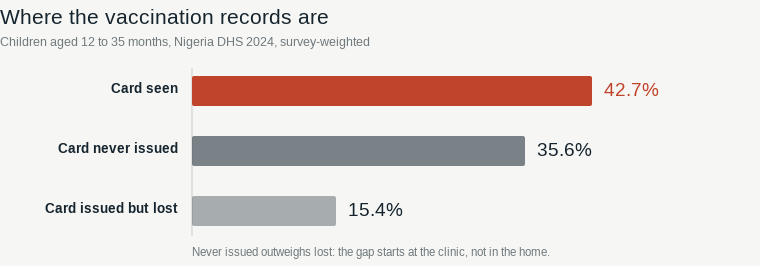
Only 42.7 percent of children aged 12 to 35 months had a card seen. Cards never issued outweigh cards lost, which moves the intervention from household education to clinic supply. And 96.8 percent of children who never had a card were zero-dose, so a missing record is rarely only a record problem.

  • R
  • Survey weighting
  • Rao-Scott tests
  • Python
  • Multilevel models

Read the case

Bar chart: card seen 42.7 percent, card never issued 35.6 percent, card issued but lost 15.4 percent
Survey-weighted estimates, Nigeria DHS 2024.

About

I came to analysis through public health, which is why I start with the decision.

In public health research you cannot separate a number from what it will be used to justify, and you learn early that the honest answer is often narrower than the one people wanted. That habit is the thing I brought with me.

So each case here names a decision maker, prices the options, and puts the limitations on the dashboard rather than in a footnote. Where the data cannot support a causal claim I say so and give a break-even threshold instead, which is a decision someone can act on without me overstating what I measured.

Outside the day job I teach coding to children, which is the fastest way I know to find out whether you can actually explain something.

Open to Data Analyst and BI Analyst roles.

Elsewhere

I write about healthcare and data careers on Medium.