Healthcare operations
One in five booked clinic appointments is never used.
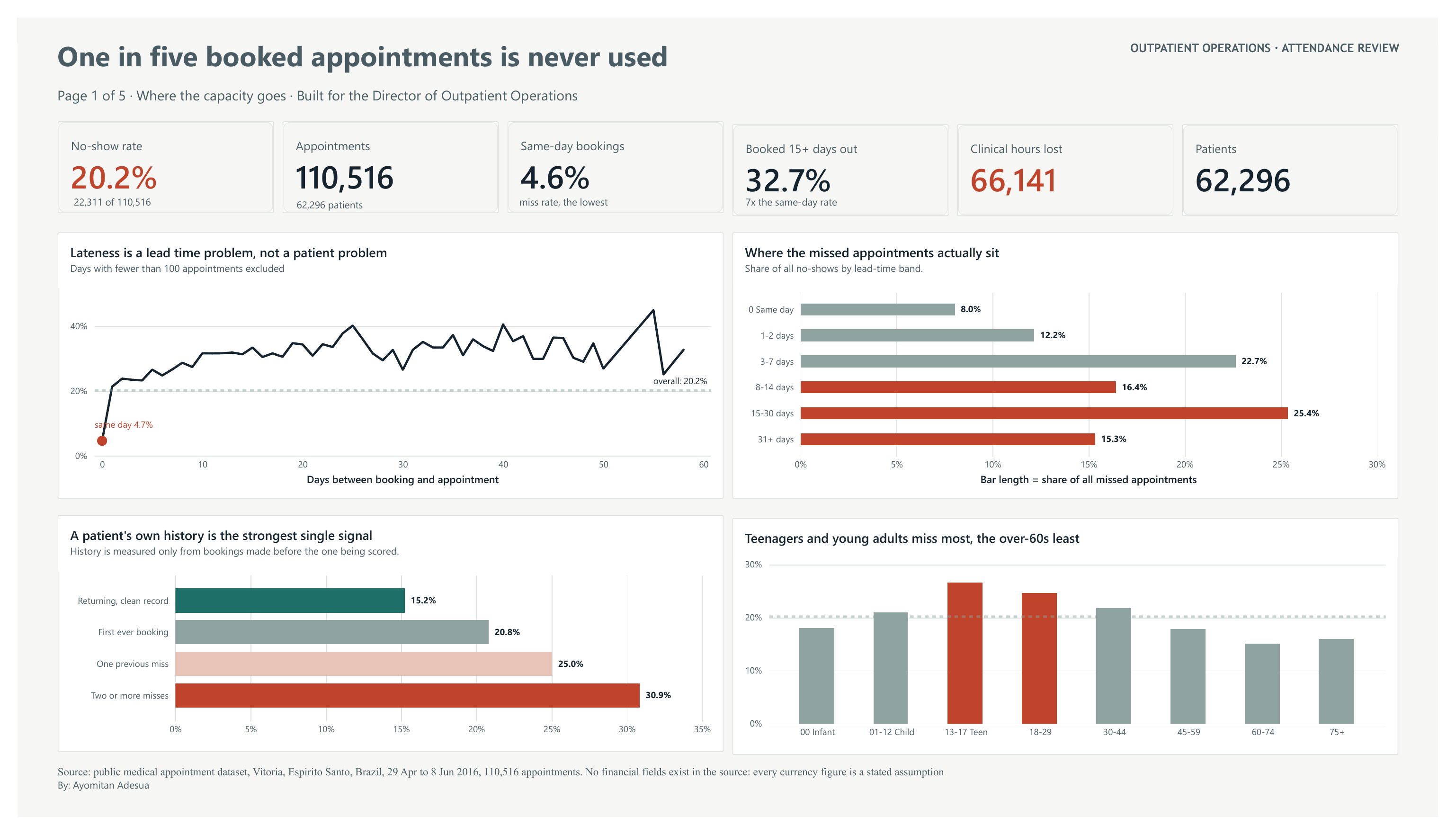
An outpatient clinic misses 20.2 percent of its appointments. The obvious explanation is the patients. It is not: it is how far ahead the appointment was booked. And the reminder data appears to say that reminders make attendance worse, which is the trap this case is really about.
- The decisionWhich appointments get a reminder, on a fixed budget, and what that recovers
- Who decidesDirector of Outpatient Operations
- Data110,516 appointments, 62,296 patients, 41 days in 2016, Vitoria, Brazil
- StackSQL (DuckDB), Python, logistic regression, Excel, Power BI
What the clinic is actually losing
22,311 of 110,516 appointments were missed. Converted into the unit an operations director manages, that is 66,141 clinical hours a year of time that was booked, staffed and then unused. Framing it as a percentage invites a shrug. Framing it as hours makes it a capacity problem with a budget attached.
Lead time, not demographics
The strongest signal in the data is how far ahead the appointment was booked. A same-day appointment is missed 4.6 percent of the time. One booked more than two weeks out is missed 32.7 percent of the time, a sevenfold difference across a variable the clinic controls directly. Age, sex and the recorded conditions move the number far less.
The trap
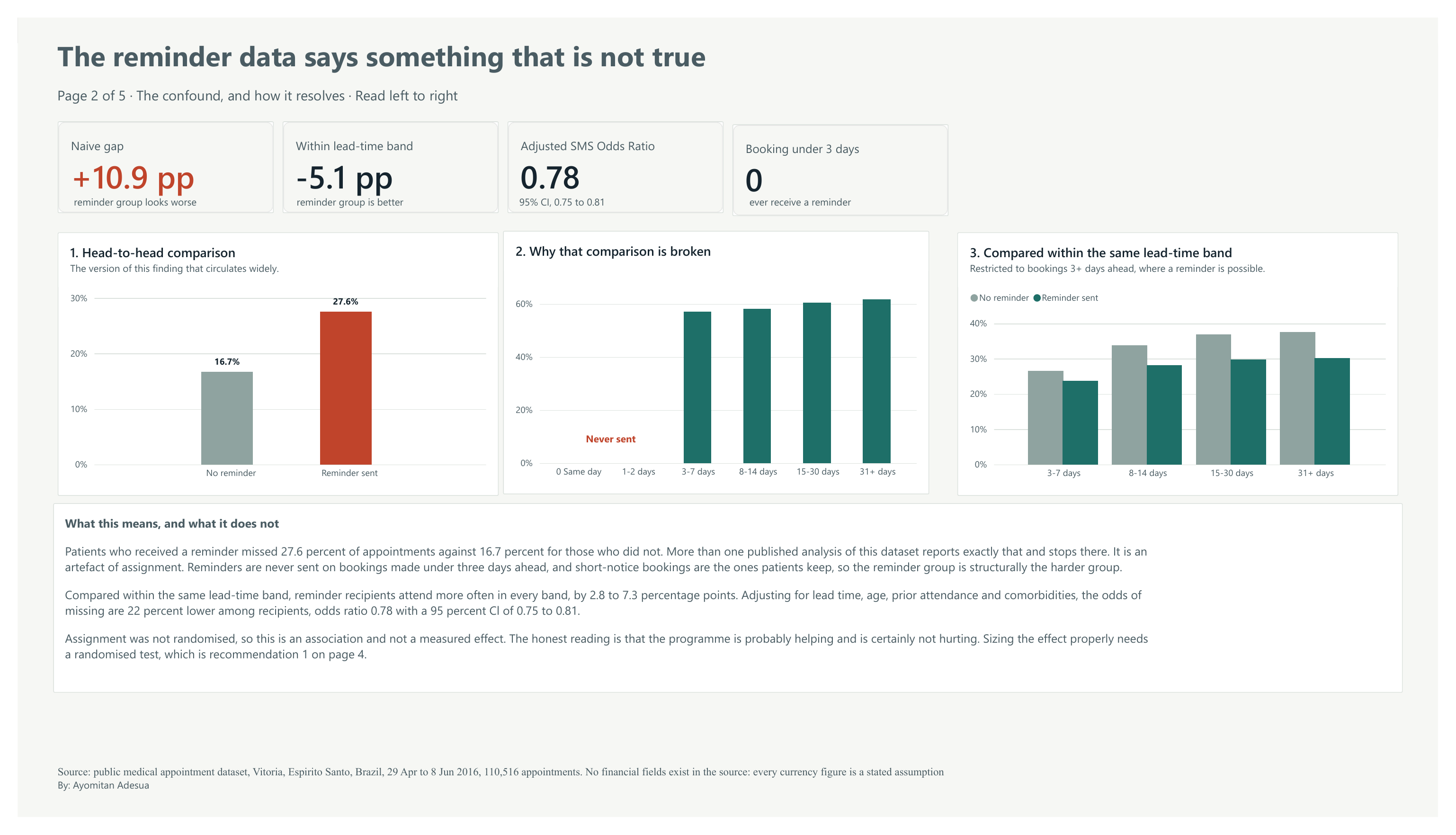
Compare patients who received an SMS reminder against those who did not, and the reminder group misses 10.9 percentage points more often. Taken at face value, that is an argument for cancelling the reminder programme.
It is an artefact of how reminders are assigned. Reminders are not sent on short-notice bookings, and short-notice bookings are the ones patients keep. So lead time drives both the reminder and the outcome, which is the textbook setup for a confound. Comparing within lead-time bands, reminder recipients attend more often in every single band: 2.8, 5.7, 7.1 and 7.3 percentage points better, all significant. Adjusted odds ratio 0.78 (95 percent CI 0.75 to 0.81).
Acting on the unadjusted number would mean switching off a programme that works.
Who to target
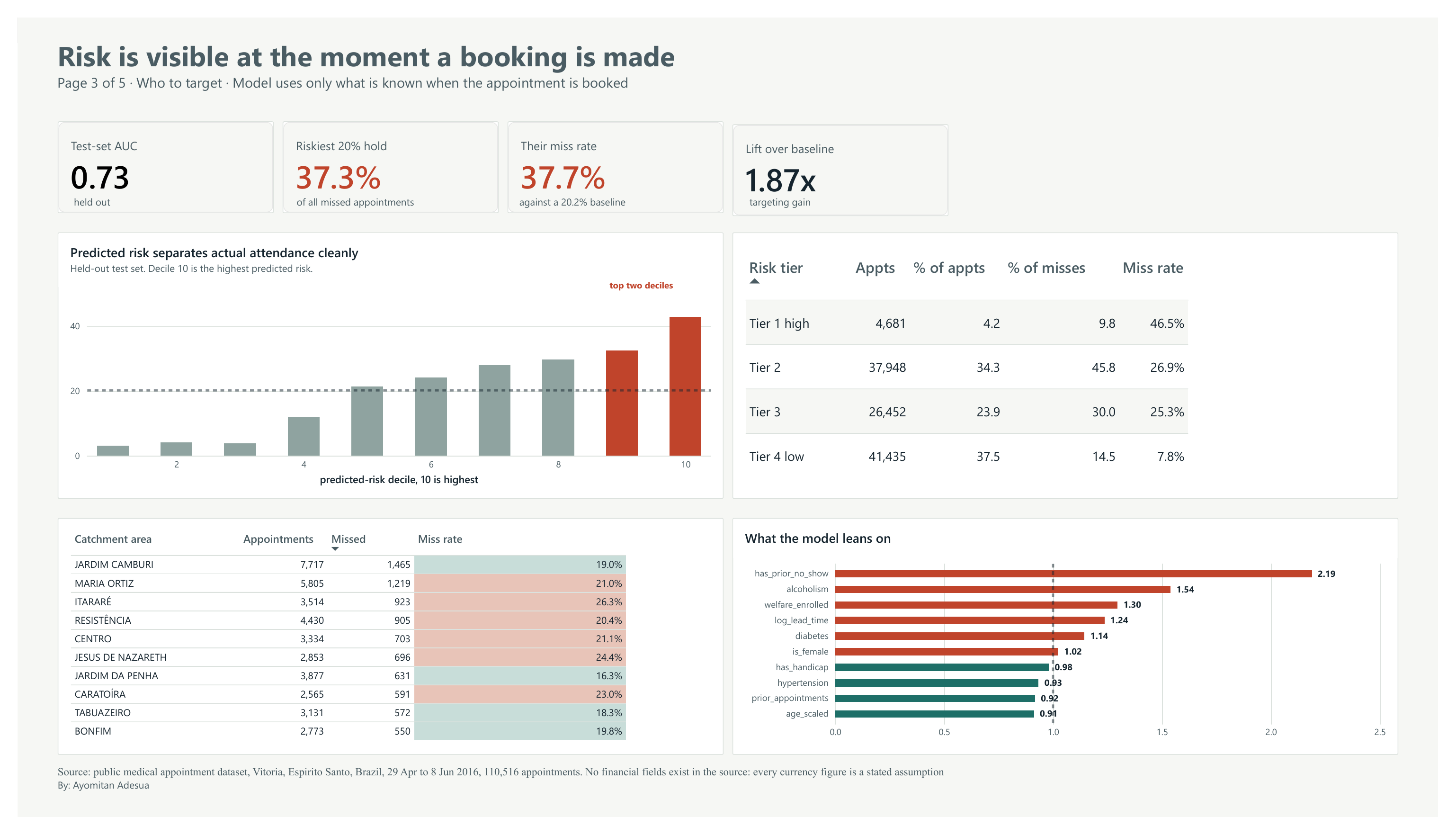
A model ranks bookings by risk, built so history features see only each appointment's own past rather than the whole patient record. It discriminates at AUC 0.73, which is useful for ordering a queue and useless for predicting an individual, and I treat it as the former.
What the decision consumes is not the score but the concentration. The riskiest 20 percent of bookings carry 37.3 percent of all the misses, a miss rate of 37.7 percent against a 20.2 percent baseline. Sharper still, the bookings that combine a prior missed appointment with a long lead time are 4.2 percent of volume and 9.8 percent of the misses, missing at 46.5 percent.
The recommendation, and the honest part
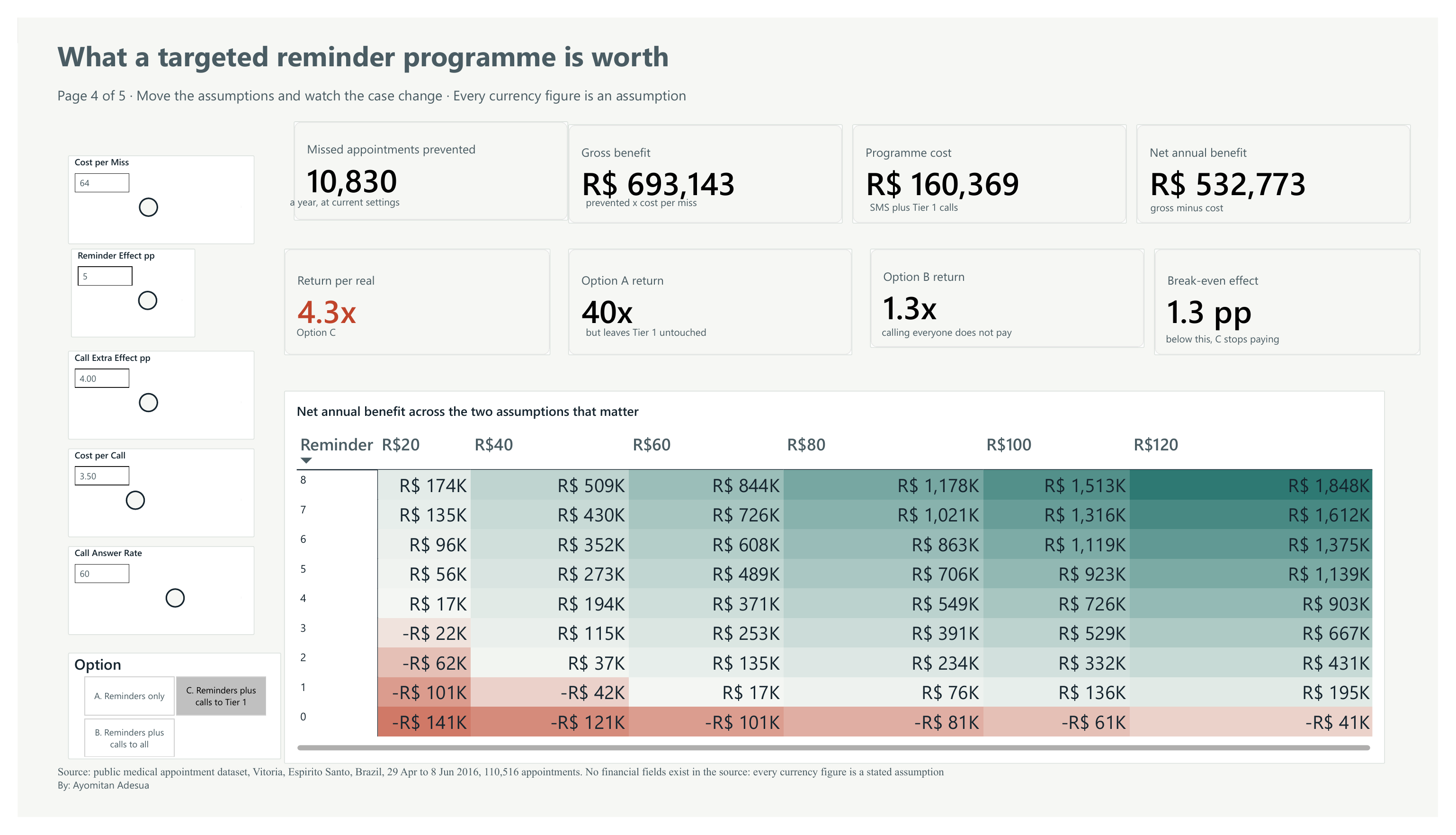
Send SMS reminders broadly, since they are close to free, and reserve staffed confirmation calls for that 4.2 percent tier. Targeting that way returns 4.3 times the programme cost, roughly R$540,000 net a year. Phoning everyone in the top risk quintile instead returns 1.3 times, because most of that quintile would have come anyway.
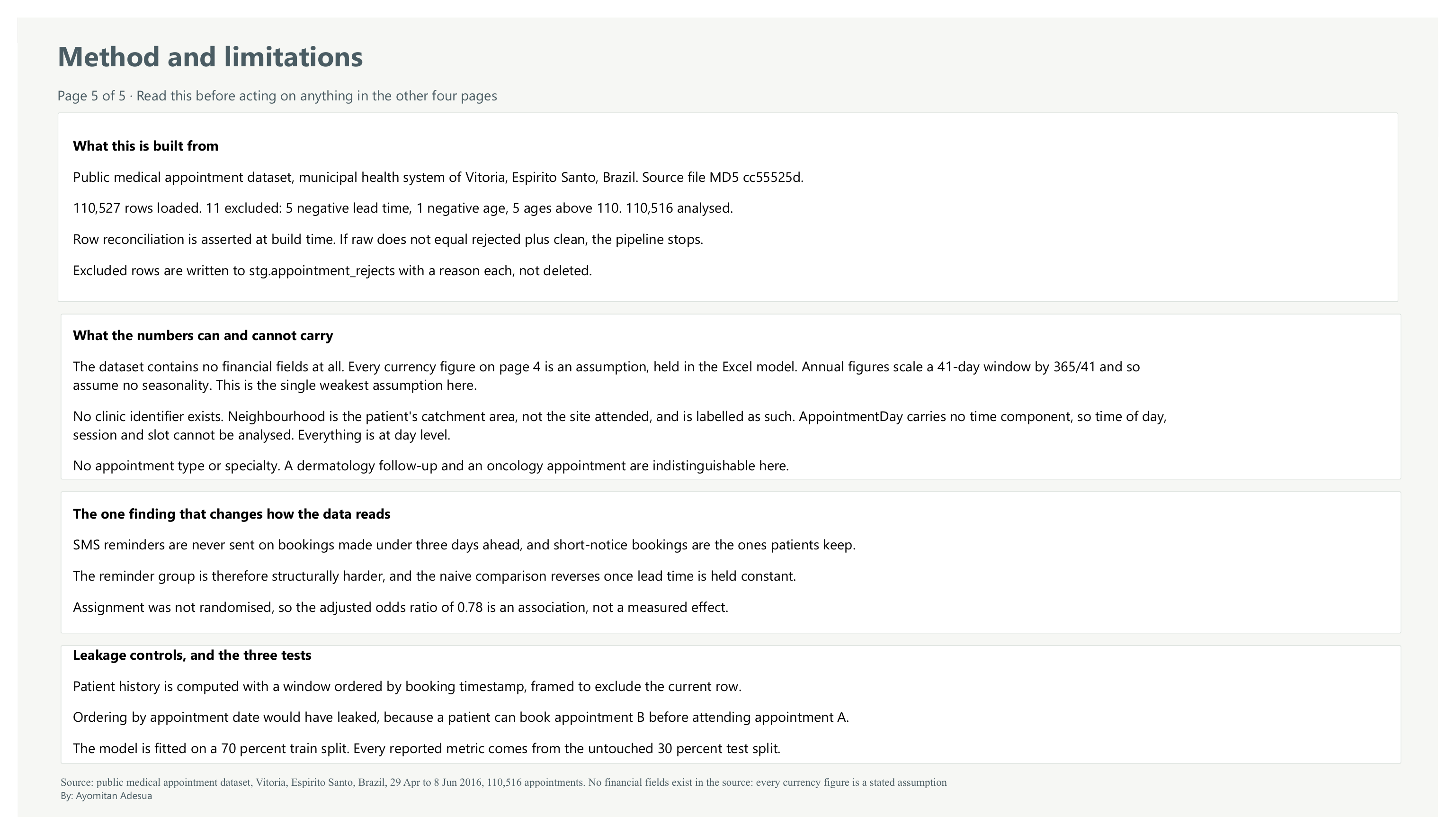
The thing I cannot do with this data is tell you how well a reminder works. Assignment was not random, and no amount of adjustment turns an observational dataset into a trial. So rather than claim an effect, the analysis asks how large an effect would have to be for the programme to pay for itself. The answer is 1.3 percentage points. Published reminder trials sit above that, so the recommendation holds across the whole range of the thing I could not measure, and the dashboard lets the director set that number herself and watch the return move.
Limitations
- 41 days of data from a single clinic in 2016. Seasonality cannot be assessed at all.
- Reminders were not randomly assigned, which is why no causal effect is claimed anywhere.
- No appointment type and no clinician, so a missed physiotherapy slot and a missed consultation are valued identically.
- The cost of an empty slot is an estimate, not the clinic's own finance figure. It sits in one editable cell.
- The data records that a reminder was sent, never that it was received or read.
- Three hypotheses were tested, chosen for what the recommendation rests on and not registered in advance. That choice is stated in the write-up rather than hidden.
Read more
- The repository, with the SQL warehouse, the Python pipeline and the Excel cost model
- The business brief, written before the analysis
- The hypothesis document, with the full test statistics