Public health
A missing vaccination card is usually a missing vaccination.
Most children's immunisation histories in Nigeria cannot be verified from a document. The usual assumption is that cards get lost at home. In the 2024 national survey, more were never issued at all, which moves the intervention from household education to clinic supply.
- The questionWhich gap to close first so children's vaccination records stop going missing: cards never issued, cards lost at home, or the states where both fail
- DataNigeria Demographic and Health Survey 2024, children aged 12 to 35 months, survey-weighted
- StackR (survey-weighted estimation, Rao-Scott tests, multilevel models), Python
- Type of workResearch-grade survey analysis rather than a costed business case
What the survey shows
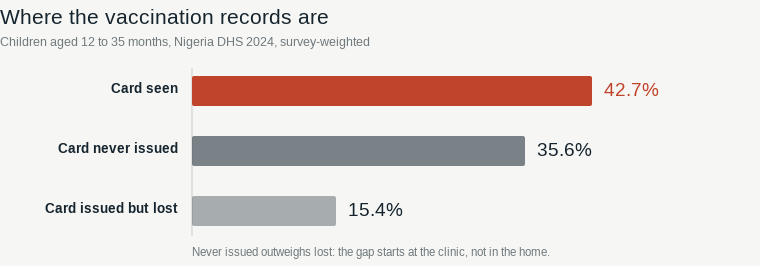
Only 42.7 percent of children aged 12 to 35 months had a vaccination card seen by the interviewer. That is the share of the country's young children whose immunisation history can be checked against a document rather than taken from a caregiver's memory.
Why the direction matters
Cards never issued (35.6 percent) outweigh cards issued and then lost (15.4 percent). Those two findings point at completely different programmes. Lost cards are a household problem, addressed with replacement cards, reminders and caregiver education. Cards never issued is a supply and process problem at the point of contact, addressed with stock, printing and whatever is stopping staff issuing one.
Most of the published framing assumes the first. The data says the larger share is the second, so a programme built around caregiver education would be aimed at the smaller half of the problem.
Cards never issued outweigh cards lost. The gap starts at the clinic, not in the home.
The record and the vaccination are the same problem
96.8 percent of children who never had a card were zero-dose. A missing document is therefore a very poor proxy for a documentation failure: in almost every case the child had also not been vaccinated. That reframes the card from a record-keeping artefact into a marker of contact with the health system at all.
Antenatal care is where that contact begins. Any antenatal visit cuts the odds of a child never receiving a card by 57 to 71 percent, which puts the leverage point earlier than the immunisation visit itself.
The methodological part
The analysis does not take a reported dose at face value. Every reported vaccine dose is traced to its source of evidence: a date written on the card, a mark on the card without a date, or caregiver recall with no document at all. Zero-dose status is then computed under alternative definitions, so the headline figure can be tested against how strictly you choose to count.
Estimates are survey-weighted throughout, with Rao-Scott tests and logit confidence intervals, because the DHS sample is clustered and stratified and treating it as a simple random sample would understate every standard error.
Limitations
- Cross-sectional. Nothing here establishes that antenatal contact causes a card to be issued, only that the two travel together.
- "Card seen" depends on a card being produced during the interview, so it is a floor on documentation rather than an exact measure of it.
- Doses resting on caregiver recall carry recall error in both directions, which is the reason the evidence-source breakdown exists at all.
- The survey measures whether a card exists, never why a particular clinic did not issue one. The supply explanation is an inference from the pattern, not a measurement.
Read more
- The analysis code, with the R and Python pipeline and a reproducible run script